

Start Strong Part 2: Sell All for the Ultimate Riches
READ PART 1 OF THIS BLOG SERIES HERE
Some things only reveal their true value with time.
Jesus understood this. That's why His most striking parables about the Kingdom compare it to something whose worth is not immediately visible—treasure buried in a field, a pearl recognized only by the one who knew what to look for.
The cost of following Christ isn't hidden. But the reward often is. And that's precisely the point.
The Kingdom as Hidden Treasure
Jesus describes the Kingdom of God in images that subvert our expectations:
"The Kingdom of Heaven is like treasure hidden in the field, which a man found and hid. In his joy, he goes and sells all that he has, and buys that field."
— Matthew 13:44 (WEB)
And again:
"The Kingdom of Heaven is like a merchant seeking fine pearls, who having found one pearl of great price, went and sold all that he had, and bought it."
— Matthew 13:45–46 (WEB)
Notice what both parables share: the treasure required everything. The man sold all he had. The merchant liquidated his entire inventory. From the outside, this looks like recklessness—or loss.
But notice what else they share: joy.
The man who found the treasure didn't grieve as he signed over his possessions. He moved in joy. He had found something worth more than all he possessed. The merchant wasn't suppressing his desires—he was finally satisfying them.
This is the great inversion of the Kingdom. We imagine that following Christ means settling for less, giving up what we truly want. But Jesus insists the opposite is true. The one who sees the treasure clearly doesn't experience surrender as loss. He experiences it as the only sane response.
A Gem That History Forgot—Then Remembered
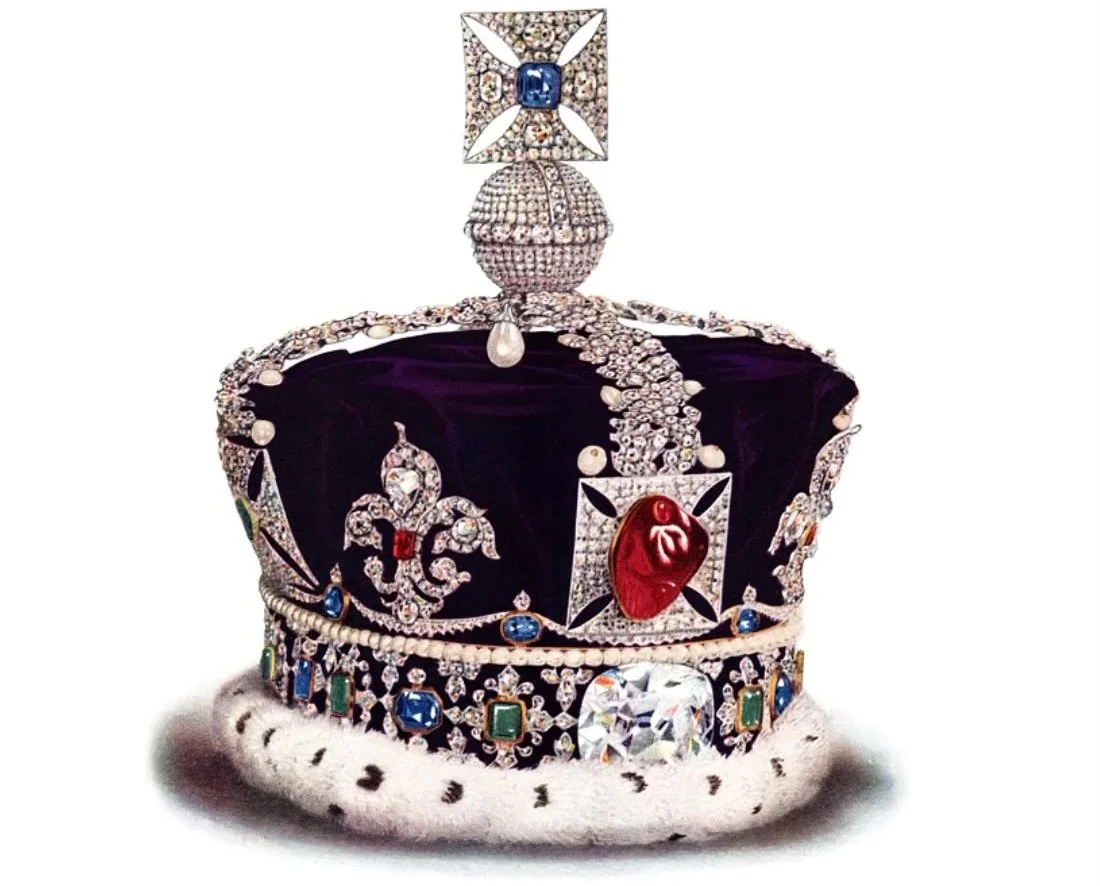
History offers a striking parallel in the story of the Black Prince's Ruby—one of the most famous gemstones in the world, now set at the front of the British Imperial State Crown. (You can view images of the crown and stone at the Royal Collection Trust or Historic Royal Palaces.)
The gem's journey spans centuries of war, betrayal, and upheaval. It passed from a murdered Moorish prince to Pedro the Cruel of Castile, then to Edward the Black Prince as payment for military aid. King Henry V wore it mounted on his battle helmet at Agincourt, where it survived a blow that could have killed him. Richard III carried it into his final battle at Bosworth Field.
But the most revealing chapter came during the English Civil War.
After the execution of Charles I, the Commonwealth ordered the Crown Jewels inventoried and sold. This was not a misunderstanding of value—it was a rejection of meaning. Royal treasures were deliberately stripped of identity and reduced to raw commodities.
In the surviving records appears an entry for "a pierced balas ruby wrapped in paper by itself," sold for £4. Some historians believe this may refer to the Black Prince's Ruby itself. If so, a treasure of immense historical significance—worn by kings, carried into battle, passed through dynasties—was treated as an anonymous stone and sold for what amounts to roughly $1,000 today.
Today, the gem is no longer assigned a monetary value at all.
Writing in 1919, gemologist George Frederick Younghusband addressed the question directly: "The question is often asked: 'What is the value of this stone?' And the answer may safely be given that it is priceless, for no amount of money can buy it."
To grasp what "priceless" means, consider this: the gem isn't even technically a ruby but a rare 170-carat red spinel—one of the largest uncut spinels in existence. In 2015, the Hope Spinel, a 50-carat red spinel, sold at auction for $1.5 million—about $30,000 per carat. If the Black Prince's Ruby were valued by that standard, it would be worth over $5 million as a stone alone.
But it isn't valued by that standard. Its worth lies beyond material calculation, bound up with centuries of survival and meaning. The stone itself is magnificent. The history it carries is incalculable.
The Parallel to Jesus' Teaching
Here is the point Jesus wants us to see: anyone who could have purchased that stone for £4—or even $5 million—would have been wise to do so, even if it cost them everything they had.
That is exactly the logic of the parables.
The man who found the treasure hidden in the field didn't hesitate. He sold all that he had. The merchant who found the pearl of great price liquidated his entire inventory. From the outside, it looked like recklessness. From the inside, it was the only sane response—because they had seen the true value of what they were gaining.
If someone had recognized the Black Prince's Ruby in 1650, wrapped in paper and sold for pocket change, and had mortgaged their home, sold their possessions, and borrowed from everyone they knew to purchase it—history would call them a genius. The stone now sits at the center of the most famous crown in the world, surrounded by nearly 3,000 jewels, literally beyond price.
The Kingdom of Heaven is like that.
Its value is not immediately visible. It cannot be weighed or appraised by the metrics the world uses. But to the one who sees it clearly, surrender becomes joy—not loss. Sacrifice becomes investment—not waste.
A Man Who Gave Everything for Earthly Treasure
If the logic of the parable still seems extreme, consider what men have done for treasures that will pass away.
In 1969, a former chicken farmer from Indiana named Mel Fisher moved to the Florida Keys with a single consuming goal: to find the Nuestra Señora de Atocha, a Spanish galleon that sank in a hurricane in 1622 carrying 40 tons of gold and silver, chests of emeralds, and riches almost beyond belief.
For sixteen years, Fisher searched. Day after day, he told his crew the same thing: "Today's the day." Most days, it wasn't.
The cost was staggering. Fisher worked for years without pay. He faced legal battles with the state and federal government that dragged on for nearly a decade. He lost investors. He lost credibility. And in 1975, he lost something no treasure could replace: his eldest son Dirk, his daughter-in-law Angel, and a diver named Rick Gage—all drowned when their salvage boat capsized.
Lesser men would have quit. Fisher kept searching.
On July 20, 1985—ten years to the day after his son's death—his son Kane radioed back to headquarters: "Put away the charts. We've found the Mother Lode."
The treasure recovered was valued at over $400 million: stacks of silver bars, chests of coins, gold chains, emeralds from Colombian mines, and thousands of artifacts that had lain on the ocean floor for over three centuries.
Mel Fisher gave everything for that treasure—years, money, reputation, even family. And the world celebrated him for it.
But here is the question Jesus presses: If a man will sacrifice that much for gold that will corrode and silver that will tarnish, what will you give for a Kingdom that will never end?
Fisher pursued earthly treasure with total abandon. The merchant in Jesus' parable pursued a pearl. The man in the field pursued hidden riches. All of them understood the same principle: when you find something of ultimate value, you trade everything else to possess it.
The difference is this: Fisher's treasure, however magnificent, will eventually pass away. The treasure Jesus offers is eternal.
When We Want Too Little
Many hesitate at surrender—not because they lack belief, but because the cost feels too high.
I don't want to give up this relationship.
I don't want to surrender this lifestyle.
I don't want to lose comfort, reputation, or control.
But what if the problem is not that we want too much, but that we want too little?
C.S. Lewis captured this with stunning clarity:
"We are half-hearted creatures, fooling about with drink and sex and ambition when infinite joy is offered us, like an ignorant child who wants to go on making mud pies in a slum because he cannot imagine what is meant by the offer of a holiday at the sea. We are far too easily pleased."
The child making mud pies isn't wicked. He's simply ignorant. He has never seen the sea. He cannot imagine the salt air, the crashing waves, the endless horizon. And so when someone offers him a holiday at the coast, he looks down at his mud and thinks: Why would I trade this?
That is precisely how we treat eternal life.
We clutch our small comforts, our fleeting pleasures, our carefully managed reputations—and we call it sacrifice to let them go. But what if we aren't being asked to sacrifice at all? What if we're being asked to trade mud for the sea?
"Don't lay up treasures for yourselves on the earth… but lay up for yourselves treasures in heaven."
— Matthew 6:19–20 (WEB)
When we refuse eternal treasure, we are not choosing nothing—we are choosing something infinitely less.
Selling All for What You Cannot Yet See
The merchant who found the pearl of great price had to make a decision before the full value of his purchase was realized. He couldn't prove to others that this pearl was worth everything. He simply knew.
That's the nature of Kingdom investment. Eternal life is not immediately apparent. Its value lies beyond the horizon of time. But to the one who truly sees it, surrender becomes joy, not loss.
The question isn't whether the Kingdom costs everything. It does.
The question is whether you've seen the treasure clearly enough to sell all for it—even while it remains unseen to the world around you.
What are you holding onto that feels too precious to release? And what might you be forfeiting by refusing to let go?
The merchant didn't grieve his exchange. He had found something worth more than all he possessed.
So have you.
This is Part 2 of a two-part series. Part 1, "Count the Cost," explores Jesus' parables of the tower and the warring king—and what it means to begin with the end in mind.